
SAP
Before Your Next SAP Transformation, Is Your Master Data Clean Core-Ready?
Is your SAP environment ready for the future?.
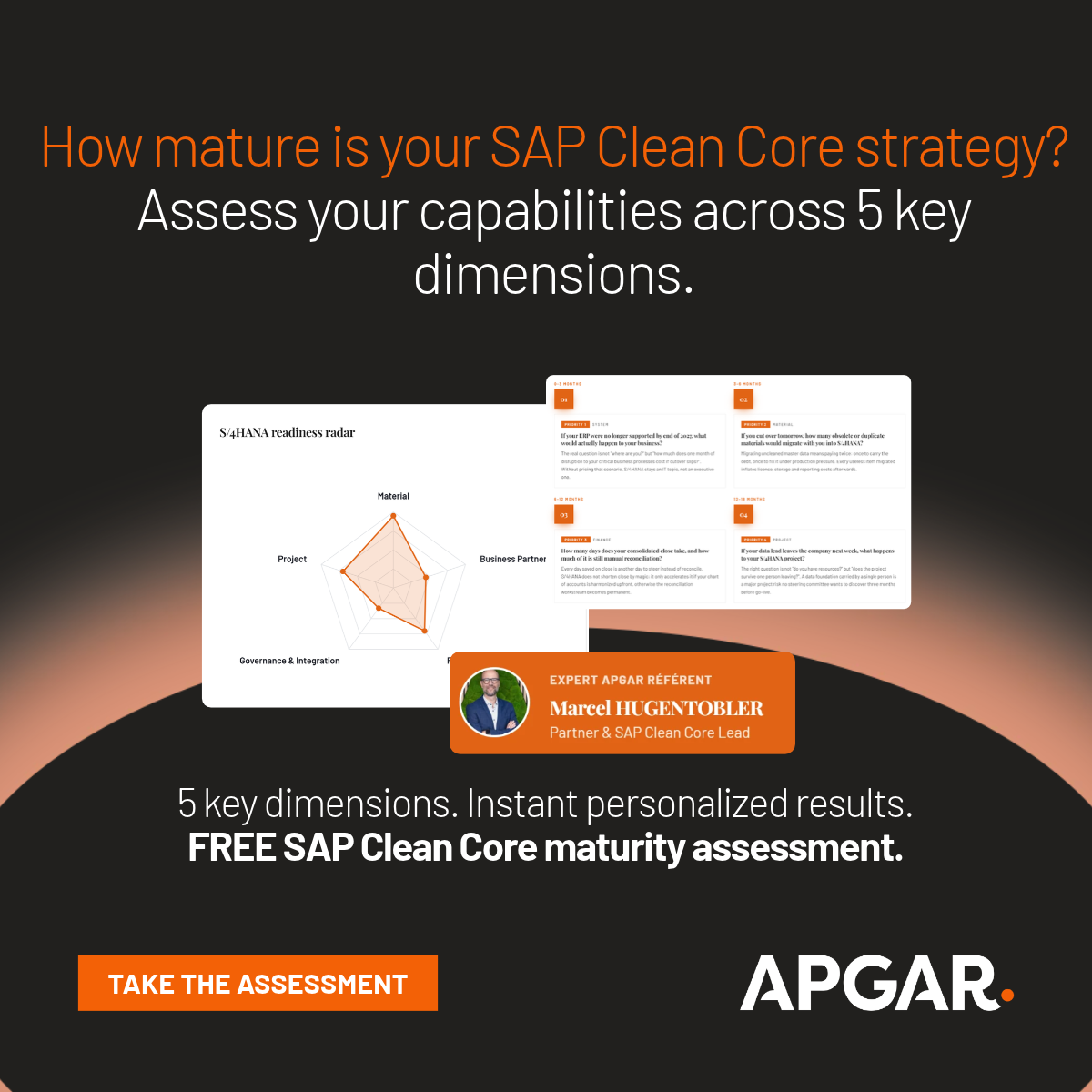
Assess the maturity of your SAP Clean Core strategy
Evaluate your organisation’s ability to adopt a Clean Core approach and maintain a modern, scalable and high-performing SAP environment.
Through a structured assessment, identify your strengths, areas for improvement and opportunities to simplify your SAP landscape, reduce technical complexity and facilitate future developments.
Explore the key dimensions of Clean Core – Processes, Extensibility, Data, Integration and Operations – to identify the main priorities for your SAP transformation.
Before Your Next SAP Transformation, Is Your Master Data Clean Core-Ready?
A cleaner SAP core can enable faster transformation. But what happens when the master data behind it is not ready?
For many organizations, SAP modernization is high on the agenda.
S/4HANA transformation, cloud adoption and new AI-enabled processes are creating opportunities to simplify landscapes, rethink operations and accelerate innovation.
But modernizing the technology alone is not enough.
Complex or inconsistent master data can continue to create friction, even in a modern SAP environment.
This makes one question increasingly important:
Are your master data foundations as ready for transformation as your SAP roadmap?
Clean Core is about more than reducing customization.

Clean Core is about more than reducing customization
Clean Core is often associated with simplifying customizations and keeping the SAP core as standardized as possible.
But from a transformation perspective, technical simplification is only part of the equation.
Organizations also need reliable master data foundations capable of supporting standardized processes, integration and future innovation.
If critical data remains inconsistent across systems or governance responsibilities are unclear, complexity simply moves elsewhere.
The objective should therefore not only be a cleaner system, but a foundation that enables the business to evolve more easily.

Master data can become a hidden source of complexity
SAP environments rarely become complex overnight.
Complexity builds progressively through years of transformation, acquisitions, local requirements, new systems and evolving processes.
Over time, organizations may face inconsistent Business Partner data, complex Material structures, fragmented governance or Finance data that does not fully align across processes.
These issues become particularly visible when organizations prepare for S/4HANA, cloud adoption or new digital initiatives.
The challenge is not simply to remove complexity. It is to understand where that complexity sits and what needs to be addressed first.
Five questions to ask before your next SAP transformation
Business Partner
Is your Business Partner data consistent?
Customers, suppliers and other business partners need clear structures and governance to remain reliable across processes.
Material
Are Material structures standardized?
Inconsistent classifications, definitions or processes can increase complexity and make harmonization more difficult.
Finance
Is your Finance data ready?
Financial master data must align with evolving business structures and processes while remaining trusted across the organization
Governance
Is governance helping simplify your landscape?
Governance should provide clarity around responsibilities, standards and decision-making rather than introduce another layer of complexity.
Future readiness
Are your foundations ready for what’s next?
S/4HANA is only one part of the transformation journey. Cloud adoption, automation and AI-driven processes will place new demands on SAP data and governance.
Know what to simplify first.
Know what to simplify first
Not every organization faces the same SAP challenges.
One may struggle primarily with Business Partner governance. Another may face significant Material complexity. Others may need to strengthen Finance or integration before moving forward.
This is why understanding maturity matters.
The goal is not simply to label an SAP landscape as “ready” or “not ready”. It is to identify where complexity and risks are concentrated and what should be addressed first.
A clear diagnosis helps organizations move from a broad transformation ambition to targeted priorities.

Is your SAP environment ready for what's next?
APGAR’s SAP Clean Core Assessment helps identify maturity gaps and areas of risk so that your organization can focus transformation efforts where they matter most.